Bracelet Size Chart: How to Measure Your Wrist and Pick a Length
Published How we research
A bracelet that is half an inch too short will not close, and one that is an inch too long slides over the hand and gets caught on every sleeve. The fix is simple arithmetic: measure the wrist, add an allowance for the style you are making, then subtract the length of the clasp. This guide walks through taking the measurement, a working size chart for snug, standard and loose fits, and how each construction (stretch, clasped, wire, chain) changes the math.
Products from this article
The highest-scoring picks from the buying guides this article links to. Scores are our editorial assessment, not customer ratings.
As an Amazon Associate we earn from qualifying purchases. This does not change our picks. Affiliate disclosure
New to Prime? Try Prime free for fast, free shipping on eligible items.
+ 10500pcs is a massive supply for parties and classrooms
From our guide: Best Bracelet Making Kits for Every Age and Style
+ Clear 0.5mm cord disappears inside translucent and seed bead designs
From our guide: Best Elastic Cord for Stretch Bracelets
+ Stainless steel clasps resist rust and tarnish in daily wear
From our guide: Best Jewelry Clasps for Handmade Necklaces and Bracelets
+ 100 floss strands give a huge range of color combinations
From our guide: Best Bracelet Making Kits for Every Age and Style
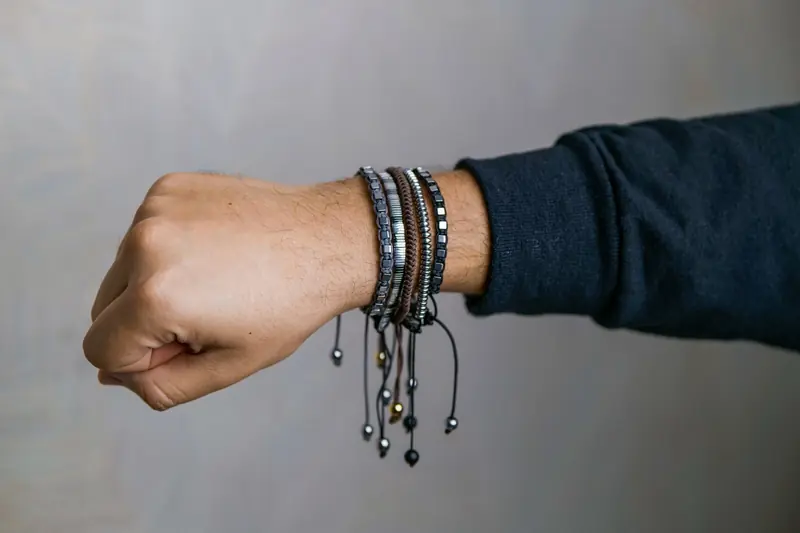
How to measure a wrist accurately
Use a flexible tape measure, the kind sold for sewing. If you only have a rigid ruler, wrap a strip of paper or a piece of string around the wrist just below the wrist bone, mark where it overlaps, then lay it flat against the ruler. Keep it snug but not tight, and measure in inches or millimeters, whichever your cord and beads are labeled in.
Measure the wrist the bracelet will actually sit on, ideally the one you wear it on every day, because many people have a slightly larger dominant wrist. Take the measurement twice. Wrists swell a little in heat and after exercise, so measuring at an unusual moment can throw the number off by a fraction of an inch. If you are making a gift and cannot measure, ask for the length of a bracelet they already wear comfortably and measure that one flat, end to end.
Bracelet size chart by fit
The usual rule of thumb is to add to the wrist measurement, not to guess. For a snug fit that sits close to the wrist, add about half an inch (roughly 1.25 cm). For a standard fit that moves a little, add about one inch (2.5 cm). For a loose, drapey fit, add about one and a half inches (3.75 cm). These are common maker conventions rather than a fixed standard, so treat them as a starting point and adjust to taste.
As a worked example, a 6 inch wrist becomes about 6.5 inches snug, 7 inches standard and 7.5 inches loose. A 7 inch wrist becomes about 7.5, 8 and 8.5 inches. Many ready-made women's bracelets are sold around 7 inches and many men's around 8 inches, but sizing varies by brand, so measure the person instead of relying on the label.
Write the finished length down as the total length of the bracelet when closed, including the clasp. This is the figure you will work backward from when you cut cord, wire or chain.
Subtracting the clasp and findings
A clasp, jump rings and crimp covers all take up space, so the beaded or chain section is shorter than the finished length. Lay the closed clasp on your ruler and measure it, along with any jump rings or extender chain you plan to use. Subtract that total from the target length to get the length you actually need to fill with beads or links.
For example, a standard fit for a 7 inch wrist is 8 inches. If the clasp and two jump rings measure about three quarters of an inch together, you would fill roughly 7.25 inches with beads. An extender chain of one to two inches at the end is a forgiving option when you are not sure of the size, and it lets the wearer adjust the fit later.
Adjusting the size for stretch bracelets
Stretch bracelets are the exception to the clasp math, because there is no clasp and the cord stretches over the hand. Many makers build them close to the snug measurement, since the elastic expands to pass over the knuckles and then settles back on the wrist. Beads that are large or numerous will limit how far the bracelet can stretch, so a chunky 10mm bead design needs a little more length than a strand of 4mm beads.
Remember that the knot takes up some length too. Make the bracelet, check it over a hand before you trim the tails, and keep a few spare beads so you can add or remove one if it feels off. Our guide to elastic bracelets covers cord choice and knots in more detail.
Sizing by bead count and wire length
Once you know the length to fill, convert it to a bead count by dividing by the bead size. Round beads measure their stated diameter, so a 6mm bead takes up about a quarter inch, which means a 7 inch strand holds around 28 to 30 of them. Our bead size chart gives counts for each common millimeter size so you do not have to calculate each time.
For wire bracelets and memory wire, the logic changes. Rigid cuff-style wire is formed around the wrist, so measure the wrist and add the same allowance, then check the shape on the person if possible. Memory wire is sold in sizes labeled for the wrist, and the coil is made to be wrapped more than once, so follow the size on the package rather than the single-loop measurement.
Checking the fit before you finish
Before you attach the final clasp or trim the tails, wrap the unfinished strand around the wrist and see how it sits. You should be able to slide one finger under a standard fit with a little resistance, and a loose fit should move freely without dropping past the hand. If you are unsure, build the bracelet a bit long: it is easier to shorten a strand than to lengthen one.
Keep notes on each person you make for. A short card with the wrist measurement, the fit you chose and the clasp type saves time on repeat orders and gifts, and it lets you refine your own conventions over several projects rather than starting over each time.
Frequently asked questions
What size is a standard bracelet? There is no single standard. Many women's bracelets are sold around 7 inches and many men's around 8 inches, but the right length is the wrist measurement plus the fit allowance you prefer, so measure first.
Should a bracelet be tight or loose? That depends on the style. Beaded stretch bracelets and bangles are usually worn snug, while chain and charm bracelets are often worn looser so they can move and catch the light. Choose the allowance that fits how the wearer likes to wear jewelry.
Popular right now
- Seed Bead Size ChartArticle
- Choosing Beading WireArticle
- Best Jewelry Making Travel Cases for Crafting AnywhereBuying guide
- Best Bead Reamers for Enlarging and Smoothing Bead HolesBuying guide
- Best Bead Spinners for Fast Seed Bead StringingBuying guide
- Best Crimp Beads and Crimp Tubes for Secure BeadingBuying guide
Based on the last 28 days of search and visitor data.